
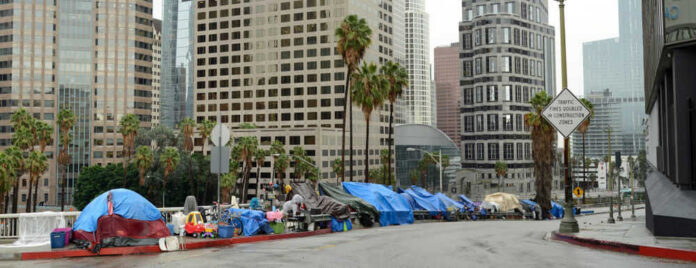
Federal housing officials suspended Los Angeles’s homelessness agency from new funding after launching an inspector general probe, raising sharp questions about where hundreds of millions actually went.
Story Snapshot
- Housing and Urban Development suspended Los Angeles’s homelessness authority from future federal funds amid an inspector general investigation.
- County auditors say audited financials were not available and internal records showed an $829 million budget, limiting transparency.
- Independent reviews found the city’s homelessness spending trail was so poor that tracking billions was nearly impossible.
- Los Angeles Homeless Services Authority reported underspending by $108 million in the last fiscal year reviewed.
HUD’s Suspension And What Triggered It
United States Department of Housing and Urban Development (HUD) officials announced in June that the Los Angeles Homeless Services Authority was “immediately” suspended from future federal funding opportunities after the HUD Office of Inspector General opened an investigation. The department cited patterns of financial mismanagement and control failures. The action matters because federal money made up a significant share of the agency’s work and signals deep concern over basic stewardship of taxpayer dollars.
HUD’s move comes while House Republicans seek testimony from Los Angeles Mayor Karen Bass about how homelessness dollars have been handled. Committee members want to know whether federal Continuum of Care funds were tracked, whether vendors delivered services billed, and why books and records could not support simple questions. These are not minor paperwork errors. They go to trust, accountability, and whether public money produced real placements for people on the streets.
Auditors Flag Missing Records And Poor Controls
The Los Angeles County Auditor-Controller reviewed the homelessness authority’s finances this spring. Audited financial statements for the prior year were not available at the time of review, and internal records showed a total budget of about $829 million. That size demands strong controls and clean books, but auditors found gaps that limited clear answers. The same environment makes it easy to hide errors, double-pay invoices, or fail to verify services before cutting checks.
Separate court-ordered and independent audits of the city’s homelessness spending described a broken paper trail. Reviewers said the documentation was so poor that tracking how billions were used was nearly impossible. They also reported the city failed to verify whether services invoiced were actually provided. When records are that weak, it invites waste and abuse, even if prosecutors have not yet named a specific fraudster or filed charges tied to a given transaction.
Underspending And Results Claims Under Scrutiny
Reporting based on county findings says the homelessness authority underspent its overall budget by $108 million in the fiscal year that ended in June 2025, including millions in federal dollars. That means money meant to move people from tents to beds sat idle while encampments spread. Supporters argue underspending is not theft. That is true. But it still points to slow execution and poor planning when need is urgent and costs rise for taxpayers each month.
The Trump administration’s 2026 budget singled out the Los Angeles agency, calling its record “abysmal” and pointing to the independent audit that found failures to accurately track billions in federal and local dollars. Federal leaders are now pressing for performance that can be measured and verified. They want clean data on placements, occupancy, and outcomes tied to every dollar. That is basic accountability, not partisan theater, when the sums are this large.
What Bass And LAHSA Say In Defense
Los Angeles officials push back, saying audits found no evidence of fraud or graft. The homelessness authority says it welcomes reviews, has cooperated with federal provider-fraud investigations, and reports progress on interim housing occupancy and permanent housing use. The agency also points to more than 20,000 permanent housing placements per year in recent years. These are important claims, but they do not answer why auditors still could not reliably match spending to services.
Mayor Bass notes the city declared a homelessness emergency and says homelessness counts fell two years in a row. She argues new strategies are replacing a broken status quo. Even so, the county is considering major restructuring, and federal officials have moved to suspend future funds while the probe runs. That split picture is the point of the House inquiry: distinguish real gains from glossy reports, and force a clean ledger that taxpayers and Congress can trust.
What Congress Wants To See Next
House investigators want transaction-level records: grants, drawdowns, invoices, site logs, and vendor monitoring files. They want to test whether federal dollars went to eligible uses and whether billed services actually happened. They also want corrective action plans that show when fixes were due, who was responsible, and what changed after the 2025 and 2026 audits. If results are strong, the data should prove it. If not, reforms and clawbacks must follow to protect taxpayers.
Why It Matters For Taxpayers And The Constitution
Every dollar lost to loose books or weak oversight is a dollar not spent on housing veterans, cleaning up encampments near schools, or restoring public order. Conservatives believe aid should come with strict accountability, limited bureaucracy, and clear results. HUD’s suspension and the House probe aim to enforce that standard. The system must show outcomes that match the money, with records any citizen can audit. That is how trust is rebuilt and waste is ended.
Sources:
redstate.com, hud.gov, file.lacounty.gov, san.com, laist.com, therealdeal.com, wabcradio.com, latimes.com