

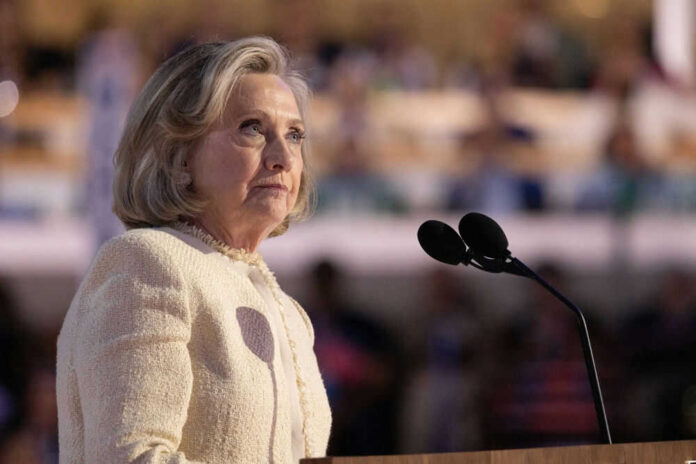
Hillary Clinton just kicked off a “girls’ rights” panel by spotlighting a transgender member of Congress—an optics bomb that reignited the national fight over whether “women’s rights” still means biological women and girls.
Story Snapshot
- Hillary Clinton moderated a Munich Security Conference panel on Feb. 14, 2026 titled “Girls Just Want to Have Fundamental Rights: Fighting the Global Pushback.”
- Clinton opened by interviewing Rep. Sarah McBride (D-DE), described as the first openly transgender member of Congress and introduced as a “gender rights champion.”
- McBride argued that “threats toward trans people are threats toward all women,” tying anti-trans policies to broader sexism and misogyny.
- The event landed during a U.S. partial government shutdown tied to DHS funding, with reporting that official congressional travel was canceled.
- Conservative critics framed the moment as emblematic of elite progressive messaging that blurs sex-based protections for girls.
Munich panel puts “girls’ rights” and gender politics on the same stage
Hillary Clinton appeared at the Munich Security Conference on February 14, 2026 to moderate a session titled “Girls Just Want to Have Fundamental Rights: Fighting the Global Pushback.” The opening exchange featured Rep. Sarah McBride of Delaware, described in reporting as the first openly transgender member of Congress, whom Clinton praised as a “gender rights champion.” Clips from the panel circulated quickly, turning a conference discussion into a familiar U.S. culture flashpoint.
The central dispute is not whether women deserve equal protection—Americans overwhelmingly agree they do—but what “girls” and “women” mean when policy is written. Critics argue that collapsing sex and gender identity affects real-world rules: sports categories, locker rooms, shelters, prisons, and privacy standards that were originally built around biology. Supporters counter that expanding protections to transgender people strengthens civil rights and counters discrimination.
McBride’s message: anti-trans policy is a gateway to broader rollbacks
Rep. McBride’s remarks in the circulated video argued that attacks on transgender people are connected to a wider “regressive” movement. McBride linked “transphobia, homophobia, misogyny, and sexism,” and framed restrictions targeting transgender people as a template that can later be applied to women in general. In that telling, enforcing sex-based boundaries becomes a form of “gender policing” with spillover effects beyond the transgender population.
That claim is politically significant because it recasts a dispute over definitions as a dispute over basic safety and equality. Conservatives looking at the same facts often reach the opposite conclusion: sex-based boundaries exist precisely to protect women and girls, including in intimate spaces and competitive athletics. The research provided does not include neutral third-party analysis of the “gateway” theory, but it does show how Democrats are increasingly presenting transgender rights as inseparable from women’s rights.
Shutdown backdrop underscores the “elite priorities” critique
The panel also unfolded during a partial U.S. government shutdown tied to a DHS funding lapse. Reporting indicated official congressional travel was canceled, while McBride still attended in a private capacity. That timing mattered to many Americans watching from home: they have lived through years of inflation, border chaos, and Washington dysfunction, and they are quick to notice when high-profile political figures take international stages to litigate social ideology while basic governance breaks down.
Munich is a major security forum, and U.S. political figures often use it to signal priorities to allies and activists. The provided research notes other prominent Democrats attending in 2026 as well. For conservatives, the question is whether the “girls’ rights” framing was meant to persuade the center or to energize a progressive coalition that treats sex-based concerns as outdated. Either way, the controversy shows how quickly domestic disputes now travel globally.
Why the wording matters for law, culture, and parental authority
When public leaders place transgender representation at the center of a “girls’ rights” panel, the practical question becomes how institutions define protected classes. Sex-based protections for women are deeply embedded in American life, from Title IX-style athletics debates to privacy and safety policies in schools. Parents and female athletes tend to focus on clear categories, while progressive messaging often emphasizes identity-based inclusion even when boundaries become harder to enforce.
Can't Make It Up: Hillary Clinton Opens Girls' Rights Panel by Interviewing… Transgender Lawmakerhttps://t.co/x93Eatjmdx
— RedState (@RedState) February 15, 2026
What can be said from the research is straightforward: Clinton and McBride used the panel to frame transgender-rights pushback as part of a broader campaign against women, while conservative outlets highlighted the irony of featuring a transgender lawmaker in a “girls” forum. No specific new policy was announced at the event. The lasting impact is rhetorical and political—fuel for 2026 debates about women’s spaces, youth policy, and whether activists are redefining words faster than voters will accept.
Sources:
https://www.hillaryclinton.com/issues/lgbt-equality/
https://www.washingtonblade.com/2026/02/11/top-democrats-re-introduce-trans-bill-of-rights/
https://www.foxnews.com/politics/hillary-clinton-says-migration-went-too-far-needs-fixed-humane-way
https://www.thegatewaypundit.com/2026/02/hillary-clinton-hosts-panel-fundamental-rights-women-her/