
France’s establishment left just held Paris—while Marine Le Pen’s movement pulled off a headline-grabbing city takeover that signals real momentum heading into 2027.
Story Snapshot
- Socialist Emmanuel Grégoire won Paris and will succeed Anne Hidalgo, extending left-wing control of the capital that has lasted since 2001.
- Marine Le Pen’s Rassemblement National (RN) scored a historic breakthrough by winning Nice, a major French Riviera city.
- Several big-city contests remained unsettled in the reporting, including Marseille, Lyon, and Strasbourg, with tight first-round splits.
- A recent change to election rules in Paris, Lyon, and Marseille lowered the “majority bonus” to 25%, reshaping how local power is won.
Paris Stays Socialist as Grégoire Replaces Hidalgo
Paris voters chose continuity, electing Socialist Emmanuel Grégoire to succeed outgoing mayor Anne Hidalgo after the March 22, 2026, second round. First-round results showed Grégoire leading with 36.5%, ahead of right-wing candidate Rachida Dati at 24.9% and radical-left candidate Sophia Chikirou at 13.7%. Grégoire framed the win as a mandate for a “progressive” Paris and made a symbolic bicycle trip to City Hall.
From a U.S. perspective, the Paris outcome underscores how major global capitals often remain anchored to high-tax, centralized governance even as public patience wears thin. For conservatives watching Europe’s direction, the more important takeaway may be what Paris represents: a left-wing stronghold that the right and populists still struggle to crack. The result also keeps a prominent European city under leadership aligned with the broader “green-left” governing style.
Le Pen’s National Rally Breaks Through in Nice
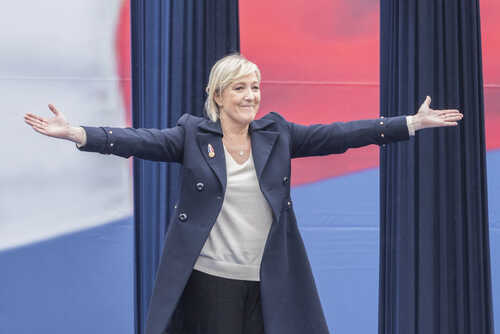
The election’s shockwave came from the Mediterranean: RN won Nice, marking an unprecedented victory for the party in a major urban center. Associated Press reporting described the win as historic, and it immediately gave Le Pen a tangible governing prize to point to ahead of the 2027 presidential campaign. Le Pen called the results a “tremendous victory,” emphasizing RN gains beyond places where it already held incumbencies.
Nice matters because local governing power is more than symbolism—it provides staffing, budgets, public-safety decisions, and the ability to demonstrate competence under pressure. Supporters argue that local control allows RN to prove it can govern rather than merely protest. Critics argue the opposite, warning about the direction of policy. The hard fact is that an RN-held major city changes the political map and forces France’s traditional parties to respond.
Knife-Edge Races in Marseille, Lyon, and Strasbourg
Outside Paris and Nice, the municipal landscape looked fragmented and volatile. Marseille’s first-round numbers showed a dead heat between left-wing incumbent Benoît Payan and RN candidate Franck Allisio, both at 35.4%, with right-wing independent Martine Vassal at 12.3%; final results were still pending in the available reporting. In Lyon, Green mayor Grégory Doucet and centrist rival Jean‑Michel Aulas were tied at 37.5% in the first round.
Strasbourg also showed a three-way split: Socialist Catherine Trautmann led the first round with 25.1%, just ahead of Les Républicains candidate Philippe Vetter at 23%, while Green incumbent Jeanne Barseghian trailed at 18.8%. These splits highlight a key dynamic: multiple left-of-center parties competing in the same cities, alongside a traditional center-right and a growing populist right. Coalition choices, not just raw vote totals, can decide outcomes.
Rule Changes and the Stakes for 2027
One underappreciated factor is the rule change affecting Paris, Lyon, and Marseille: a new law reduced the “majority bonus” to 25%. In practical terms, that adjustment can alter how easily a leading list converts votes into governing control, especially in multi-candidate fields. With French politics already splintered among Socialists, Greens, centrists, traditional conservatives, and RN, the mechanics of turning pluralities into power may become as consequential as ideology.
French Election: Socialists Secure Paris, LePen's Populists Make Historic Local Gains https://t.co/wUglSkijfs
— zerohedge (@zerohedge) March 23, 2026
The broader significance is that 2026 served as a stress test ahead of 2027, offering proof points for every camp. Socialists can claim they defended the capital; RN can claim it finally broke into major-city governance; and traditional conservatives face pressure from both sides. For Americans skeptical of globalist governance models, the takeaway is simple: political instability rises when elites ignore everyday security, cost-of-living concerns, and national identity debates—issues that don’t stay neatly contained to one country.
Sources:
French municipal elections: follow live
Emmanuel Grégoire becomes new mayor of Paris, succeeding fellow Socialist Anne Hidalgo
Socialists win Paris mayoralty in blow to French right