
Washington’s DHS shutdown has reached the point where a private billionaire is offering to pay TSA agents just to keep America’s airports moving.
Quick Take
- Elon Musk says he will cover TSA personnel salaries during the ongoing DHS funding lapse that has left essential workers without pay.
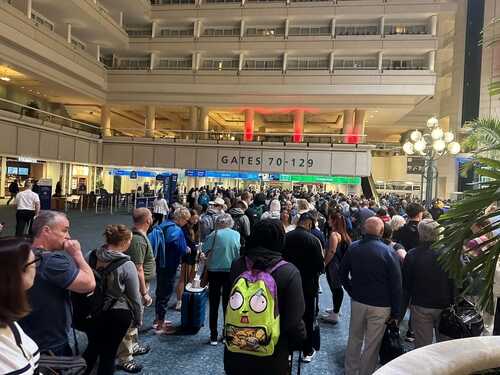
- Airport security lines have reportedly stretched past three hours at major hubs as TSA call-outs spike and staffing strains worsen.
- President Trump floated using ICE agents at airports if lawmakers still can’t fund DHS, escalating pressure on Congress to act.
- Legal and administrative barriers could prevent Musk’s proposal from being implemented the way it sounds on social media.
Musk’s Offer Highlights a Breakdown in Normal Governing
Elon Musk posted that he would like to pay the salaries of TSA personnel during the funding impasse that has disrupted airports nationwide. The offer came as the partial shutdown affecting the Department of Homeland Security moved beyond a month, leaving TSA employees working without pay while travel demand surges. Reports described long security lines and staffing shortages worsened by a hiring freeze that began last year.
Musk’s idea resonates because it addresses a simple reality: millions of Americans still need to fly, and TSA officers are still required to show up. Yet the proposal also underscores how far Congress has drifted from basic responsibilities. When private money is floated as a backstop for federal payroll, it signals that the political system is failing to perform the most elementary task—passing a funding bill that keeps essential services stable.
What’s Driving the DHS Standoff and Why TSA Is Caught in the Middle
The current lapse traces back to Congress failing to pass DHS funding, a recurring Washington problem that forces “essential” employees to work without immediate pay while other functions pause. Reporting indicates Republicans are pushing full DHS funding, while Democrats have sought a standalone approach for TSA funding that would exclude immigration enforcement disputes. That strategy leaves TSA, a visible public-facing agency, stuck in the crossfire of broader battles.
Travel Disruptions Are Compounding Under Staff Shortages and Call-Outs
TSA already screens more than 2.5 million travelers daily, and that system depends on steady staffing. During the lapse, absenteeism reportedly rose dramatically, with call-out rates described as far above normal levels. Passengers in some cities faced delays measured in hours, and some airports saw bottlenecks so severe that crowds backed up into common areas. A TSA union warning suggested the operational and security strain is not easing.
Airlines and airports also take a hit when screening checkpoints seize up. Coverage cited daily losses tied to delays and missed connections, while travelers absorb the cost in rebooked flights, lost time, and heightened stress. The situation is aggravated by the timing: spring break demand can overwhelm even a fully staffed system. When essential workers are told “keep working, you’ll get backpay later,” it predictably creates pressure on household budgets and morale.
Trump’s ICE Idea Raises Practical Questions Alongside Political Leverage
After Musk’s post, President Trump responded by suggesting ICE agents could replace TSA at airports if no deal is reached. The idea functions as political leverage, but it also raises practical questions about mission fit and training. TSA screening is a specialized function built around aviation security procedures and checkpoint operations, while ICE focuses on immigration enforcement. Any rapid substitution would need clear legal authority, defined roles, and workable operational planning.
The Core Problem: A System That Treats Essential Work as Optional to Fund
Supporters of limited government still expect government to do a few critical jobs well, and aviation security is one of them. The current shutdown shows the weakness of a budgeting culture where brinkmanship can leave frontline workers unpaid and the public stuck in chaos. Musk’s offer may be financially plausible on paper, but multiple reports stressed the legal feasibility is unclear under federal compensation rules, meaning the plan could stall even if intentions are real.
https://twitter.com/
The bigger takeaway is that emergency fixes—whether a billionaire’s checkbook or a reshuffling of federal agents—do not replace constitutional governance and accountable appropriations. Congress controls the purse for a reason: to keep public services stable and transparent. If lawmakers can’t fund DHS without turning TSA paychecks into a bargaining chip, the public should expect more disruptions, more mistrust, and more pressure for structural reform in how Washington budgets.
Sources:
Elon Musk offers pay TSA workers’ salaries amid DHS budget standoff
Musk offers to pay TSA employees salaries during partial government shutdown
Musk offers to pay TSA employees salaries during partial government shutdown
Musk offers to pay TSA amid shutdown; Trump floats ICE at airports