

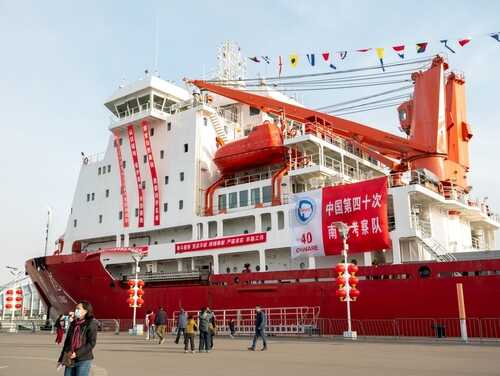
A Chinese research vessel—China’s Xue Long 2—was detected deep inside the U.S. Extended Continental Shelf off Alaska, reigniting urgent questions about foreign powers testing American resolve in the Arctic while our own Coast Guard and Canadian forces scramble to keep eyes on Beijing’s next move.
At a Glance
- China’s Xue Long 2 was tracked 130 nautical miles inside the U.S. Extended Continental Shelf north of Alaska
- The U.S. Coast Guard and Canadian Armed Forces ramped up aerial surveillance and shadowed the vessel
- The incident highlights escalating strategic competition in the Arctic as China and Russia expand their footprints
- China claims the ship’s mission is scientific, but Western experts warn of broader geopolitical ambitions
Chinese Research Ship Penetrates U.S. Arctic Waters, Testing Boundaries
On July 25, 2025, U.S. authorities detected China’s Xue Long 2—a massive, domestically built polar icebreaker flying the Chinese flag—directly inside the U.S. Extended Continental Shelf, about 290 nautical miles north of Utqiagvik, Alaska. This isn’t just another “science mission.” China’s Arctic ambitions have grown more brazen, with the Xue Long 2 venturing deep into waters where America holds exclusive rights to manage resources. The U.S. Coast Guard, on high alert, scrambled a C-130J Hercules to photograph and monitor the vessel, while Canada deployed a CP-140 Aurora aircraft based in Alaska, confirming round-the-clock patrols and joint surveillance operations. Both nations made it clear: foreign powers poking around in the Arctic will not go unnoticed.
Rear Adm. Bob Little, commander of the U.S. Coast Guard’s Arctic district, issued a blunt statement underscoring the seriousness of the matter—emphasizing that the Coast Guard remains “vigilant in monitoring foreign government vessels to protect U.S. interests.” Canadian officials, meanwhile, confirmed the vessel was not in their territorial waters but admitted active surveillance was ongoing. This is more than a blip on the radar. The Xue Long 2’s presence follows a disturbing pattern: increased joint Chinese and Russian military patrols, repeated incursions by foreign military aircraft, and a steady drumbeat of “research” missions that just happen to map or sample some of the most strategic and resource-rich waters on earth.
Arctic Chessboard: Strategic Competition Heats Up
China’s official line remains unchanged: the Xue Long 2 is conducting innocent scientific research. But the facts are impossible to ignore. China has no territorial claims in the Arctic, yet it’s building a fleet of icebreakers, mapping sea floors, and tracking resources in the High North with a tenacity that has U.S. and Canadian defense officials on edge. Arctic ice is melting, opening lucrative new shipping lanes and untapped reserves of oil, gas, and minerals. Beijing’s ambitions are as clear as the polar sky: gain leverage in the next great scramble for the Arctic, regardless of whose backyard they’re in.
Local Alaskan communities, already dealing with increased military activity and international attention, now face the prospect of their region becoming a chessboard for global powers. Indigenous leaders have raised concerns about sovereignty and the environmental impacts of relentless foreign surveillance and resource mapping. The broader U.S. public, meanwhile, is left wondering whether bureaucrats in D.C. will finally wake up to the reality that foreign powers are testing our resolve—right off our own northern shore.
U.S. and Canada Respond—But Is It Enough?
The U.S. and Canada have responded with coordinated surveillance and diplomatic signaling, but critics say more is needed. The Xue Long 2 was detected well inside the U.S. Extended Continental Shelf—a zone where America has exclusive rights to resources, but not full sovereignty. This legal gray area gives foreign “research” vessels room to maneuver, while U.S. authorities are left to shadow, report, and protest. Diplomatic notes and military flybys may not be enough to deter a regime like China’s, which has proven time and again that it respects strength, not words.
The July 2025 incident follows a series of escalating encounters: in July 2024, the U.S. intercepted Chinese and Russian bombers near Alaska—the first joint incursion of its kind. Earlier this year, Russian military aircraft again tested U.S. and Canadian airspace. Each time, the response is reactive, not proactive. The pattern is clear: China and Russia see a power vacuum in the Arctic and are moving to fill it. Meanwhile, U.S. Coast Guard and Canadian Armed Forces remain under-resourced compared to the scale of the challenge—raising questions about whether Washington is truly prioritizing the defense of America’s northern frontier.
Experts Warn of Long-Term Risks as Arctic Tensions Rise
Security and maritime experts have repeatedly warned that so-called research missions can serve dual purposes: collecting scientific data while mapping the terrain for future military or resource operations. The Xue Long 2’s incursion is already prompting calls for increased investment in Arctic defense infrastructure, more robust maritime law enforcement, and closer U.S.-Canadian cooperation. Independent analysts, like ship tracker Steffan Watkins, have mapped the vessel’s route and emphasized the growing gap between foreign activity in the Arctic and America’s ability to respond in real-time.
Western analysts agree: the Arctic is now the next great arena for power competition with China and Russia. Strategic competition over resources, shipping lanes, and influence will only intensify as the ice melts. The Xue Long 2 episode should serve as a wake-up call to policymakers and citizens alike. Without decisive action, the United States risks ceding ground—literally and figuratively—in one of the most strategically vital regions on the planet. The time for handwringing and “monitoring” is over; the time for a real American presence in the Arctic is now.
Sources:
KIRO7 – US Coast Guard detects Chinese research ship off Alaska
CBC – Canadian Forces shadow Chinese research vessel in Arctic
WorkBoat – US Coast Guard, Canadian Forces shadow Chinese research vessel
gCaptain – Chinese Icebreaker Xue Long 2 operating north of Alaska