

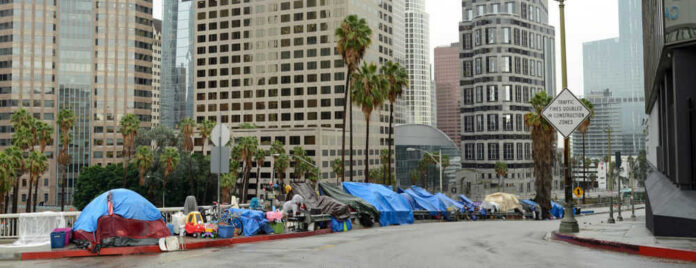
President Trump’s homelessness order is giving states new power to move dangerous, mentally ill homeless individuals off the streets and into long‑term treatment, and the Left is furious because it finally puts public safety ahead of failed “housing first” experiments.
Story Snapshot
- Trump’s 2025 executive order pushes states to use civil commitment to treat homeless people who are dangerous or cannot care for themselves.
- Federal agencies must back states with grants and legal support when they move addicts and the severely mentally ill into institutions.
- Critics call the policy “criminalization,” but they offer little hard data showing that the current approach is working.
- Several blue states are already expanding involuntary treatment, showing this is not just a conservative idea.
Trump’s Order: Putting Safety and Treatment Ahead of Street Chaos
President Trump signed the “Ending Crime and Disorder on America’s Streets” order in 2025 to tackle rising street homelessness tied to addiction and serious mental illness. The order directs the Attorney General and the Secretary of Health and Human Services to support civil commitment for people who “pose risks to themselves or the public” or are “living on the streets and cannot care for themselves.” The goal is simple and direct: shift the most unstable homeless individuals into long‑term institutional care for humane treatment and restore public order.
The order does not itself lock anyone up, but it tells federal agencies to clear obstacles that keep states from acting. The Department of Justice must seek reversal of court precedents and consent decrees that limit civil commitment standards. At the same time, agencies are told to give “technical guidance, grants, or other legally available means” to help states adopt “maximally flexible civil commitment” rules for people who are dangerous or unable to care for themselves on the streets. This is a sharp turn away from decades of “housing first” policy that often left addiction and mental illness untreated.
How States Are Using New Federal Backing
Following Trump’s order, federal housing and justice officials began prioritizing grant money for states that enforce bans on public drug use, urban camping, and loitering while expanding civil commitment options. Jurisdictions that require outpatient treatment or involuntary commitment for high‑risk individuals, and that remove encampments from public spaces, are now favored when discretionary funds are handed out. States such as California, New York, Oregon, Utah, and Texas have moved to broaden legal criteria for forced psychiatric detox and mandated care for homeless people with severe substance use disorders.
Policy analysts note that Trump’s order operates through incentives, not direct mandates, but its message to governors and mayors is clear. If a state wants federal support, it must stop treating sidewalks and parks as open‑air drug markets and tent cities. It must also build systems that move people into treatment, even when they refuse help because of mental illness or addiction. The order also urges officials to ensure people with serious mental illness are not released from facilities only because beds are short, acknowledging that decades of deinstitutionalization left too few inpatient options.
Critics Warn of “Criminalization,” But Offer Few Solutions
Left‑leaning advocacy groups quickly attacked the order, branding it “regressive” and “punitive” and claiming it would uproot constitutional protections for disabled and unhoused people. The National Homelessness Law Center and the NAACP Legal Defense Fund argue that prioritizing civil commitment and encampment sweeps amounts to criminalizing poverty. Prison Policy Initiative and academic critics insist that forced treatment “disguises criminalization as care,” warning about possible abuse inside institutions.
Governor Shapiro recently used another national political fight to portray the Trump administration’s reconsideration of federal Olmstead guidance as an attack on people with autism, intellectual disabilities, and mental illness. I think Pennsylvanians deserve the rest of the…
— James Moore (@MooreForPA) July 24, 2026
These groups highlight real risks if states cut corners on due process or pack people into poorly run facilities, but they do not present hard evidence that the status quo is working better. They rarely address Trump’s core point: some people living on the streets are so ill or addicted that they are genuinely dangerous or unable to meet basic needs. Meanwhile, commentators note that several Democratic‑led states have already moved toward more involuntary treatment because untreated street homelessness is overwhelming hospitals, police, and families.
Balancing Liberty, Street Disorder, and Real Help
The deeper debate is one conservatives know well: how to protect individual liberty while refusing to accept open lawlessness and human misery on public streets. For years, “housing first” framed the problem as mostly about rent, even when many chronically homeless individuals cycled through jail, emergency rooms, and short‑term shelters without sustained treatment. Trump’s order pushes the country back toward the idea that for a small group of people—those who are dangerous or completely unable to care for themselves—civil commitment and long‑term care are not abuses, but necessary guardrails.
There are still serious questions that must be answered to protect constitutional rights. Legal experts stress the need for clear standards on who qualifies as “cannot care for themselves,” careful court review of every commitment, and strong oversight of institutions to prevent neglect or exploitation. But for many Americans watching tents, needles, and rising crime in once‑safe neighborhoods, Trump’s policy feels less like “criminalization” and more like long‑overdue common sense. It tells states they do not have to stand by while the most vulnerable people—and the communities around them—spiral into chaos.
Sources:
cbsnews.com, whitehouse.gov, ulct.utah.gov, kff.org, nbcc.org, npr.org, youtube.com, wkar.org, nhchc.org, naacpldf.org, axios.com, hsph.harvard.edu, prisonpolicy.org, ldi.upenn.edu, aclu.org