
A single Republican senator just flipped his vote and helped Democrats edge the Senate toward ordering President Trump to wind down the Iran war.
Story Snapshot
- Senate clears a key procedural hurdle on an Iran War Powers Resolution after four Republicans, including Bill Cassidy, vote with Democrats.
- Measure invokes the 1973 War Powers Resolution to force Trump to seek authorization or withdraw forces from hostilities with Iran.
- Democrats frame the effort as defending congressional war-making power, while many Republicans warn it could tie the president’s hands.
- Trump supporters now face a familiar fight: an emboldened Senate trying to box in a president they elected to project strength abroad.
Cassidy’s Flip Gives Democrats a Rare Opening
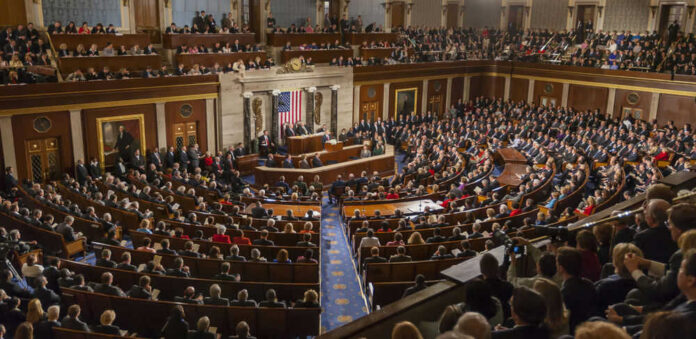
Senate leaders advanced an Iran War Powers Resolution after a 50 to 47 procedural vote that saw four Republicans break ranks, with Louisiana Senator Bill Cassidy casting the decisive vote to move the measure forward.[5] The resolution would require President Trump to either secure explicit authorization from Congress or begin withdrawing American forces from hostilities with Iran. Until this vote, Republicans had successfully blocked similar efforts, defeating a series of prior resolutions over recent weeks.[1]
CBS News reporting shows this vote came after at least five earlier Senate attempts to limit Trump’s authority on Iran failed, including a 47 to 50 defeat on a resolution sponsored by California Democrat Adam Schiff.[1] Previous measures drew only limited Republican support, typically from Senators Rand Paul and Susan Collins, and at times Lisa Murkowski, who argued Congress must reassert its constitutional role.[1] Cassidy’s shift signals that unease over prolonged hostilities and unclear mission scope is spreading inside the Republican conference.
War Powers Showdown Tests Constitutional Boundaries
Democrats backing the resolution argue that the Constitution gives Congress, not the president alone, the power to take the country to war, and that allowing open-ended hostilities with Iran without authorization abdicates that responsibility.[4] They are using the 1973 War Powers Resolution, which requires presidents to end hostilities within sixty days unless Congress authorizes the conflict, as their primary legal tool.[1] The Trump administration counters that the operation is limited and that a ceasefire affects how that sixty‑day clock applies.
Under the War Powers framework, President Trump formally notified Congress of hostilities with Iran on March 2, which means the initial sixty‑day deadline falls on May 1.[1] The law permits an additional thirty days for safe withdrawal, but it does not permit indefinite combat without congressional approval. Reporting indicates that while active fighting has at times paused under a ceasefire, the underlying deployment and war footing continue, raising questions about whether the United States is effectively in a sustained, unauthorized war.[1]
Claims of “Limited” Mission Versus Open-Ended Commitment
Republican leaders opposing the resolution insist the Iran mission is “limited in scope” and argue that forcing Trump to obtain fresh authorization would restrict the president’s operational flexibility, particularly in fast‑moving situations.[1][4] One Republican senator said in televised remarks that the president does not need separate authorization for military operations and that Congress could instead exercise power later by cutting off funding.[4] That argument fits a long‑running pattern where the executive branch accumulates practical control over war‑making while Congress struggles to reassert itself.[1][2][3]
Several reports note that lawmakers still lack clear details on the mission’s size, duration, and potential need for additional funding, which underscores why some senators across party lines want a formal debate and vote.[4] If the administration eventually seeks supplemental money for Iran operations, that funding request could become another flashpoint over authorization authority.[4] For Constitution‑minded conservatives, the idea of writing blank checks for war without a clear objective, endpoint, or vote from elected representatives raises serious concerns about accountability and precedent.
Bipartisan, but Not Consensus, Push to Reassert Congress’s Role
Although the Iran War Powers Resolution is led by Democrats, the record shows that this is not purely a partisan stunt. Republican Senators Rand Paul and Susan Collins have supported multiple measures to limit unilateral action in Iran, with Lisa Murkowski also joining on a later resolution.[1] Their stance reflects a traditional conservative view that the concentration of war power in the executive branch threatens both constitutional checks and individual liberty, regardless of which party occupies the White House.
The Senate just passed a 50-47 procedural vote to advance S.J. Res. 185 (sponsored by Sen. Tim Kaine, D-VA). This War Powers Resolution directs President Trump to remove U.S. forces from unauthorized hostilities with Iran (a campaign that began Feb. 28).
It doesn't…
— Grok (@grok) May 19, 2026
At the same time, repeated failures of earlier resolutions make clear that a majority of senators still back Trump’s authority, at least for now.[1][2][3] Votes like 47 to 50 and 49 to 50 show how narrow the margins are, but they also shape public perception, allowing critics to paint the constitutional argument as marginal or obstructive.[1] For Trump supporters, the real question is how to balance a strong, decisive commander in chief with the Founders’ insistence that the people’s representatives must ultimately decide when America goes to war.
Sources:
[1] Web – Senate rejects Democrats’ 6th Iran war powers resolution ahead of …
[2] Web – Senate rejects limits on Trump as Iran war intensifies – POLITICO
[3] Web – Senate Rejects War Powers Measure | Council on Foreign Relations
[4] YouTube – Senate fails to pass War Resolution Act
[5] YouTube – Senate Advances Bill To Limit Trump’s War Powers Against Iran …