
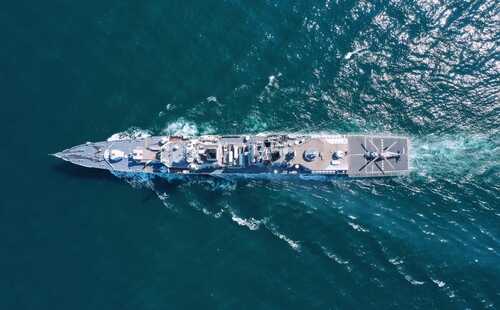
U.S. Central Command intercepted Iranian attack drones targeting American Navy destroyers in the Strait of Hormuz, forcing U.S. warships to defend themselves in one of the world’s most critical and contested waterways.
Story Snapshot
- U.S. Navy destroyers — including the USS Truxtun, USS Mason, and USS Rafael Peralta — came under attack by Iranian missiles, drones, and small boats while transiting the Strait of Hormuz.
- U.S. Central Command (CENTCOM) characterized the military response as self-defense, with American forces eliminating Iranian air defenses, a ground control station, and one-way attack drones.
- Iran accused the U.S. of violating an active ceasefire agreement, with Iranian Foreign Minister Abbas Araghchi publicly blasting the strikes as illegal escalations.
- The Strait of Hormuz, through which nearly a fifth of the world’s oil flows, remains a dangerous flashpoint as Iran continues using drone and naval harassment tactics to pressure U.S. and allied forces.
Iran Targets U.S. Warships in the Strait of Hormuz
Iranian forces launched a coordinated assault on U.S. Navy destroyers transiting the Strait of Hormuz, firing missiles, deploying one-way attack drones, and sending small boats against the American ships. U.S. Central Command responded swiftly, describing the action as self-defense. American forces eliminated Iranian air defense positions, a ground control station, and multiple drones that posed a direct threat to U.S. personnel and vessels. The exchange marked one of the most direct U.S.-Iran naval confrontations in the ongoing regional conflict. [1]
The Strait of Hormuz is not just a military battleground — it is the economic jugular of global energy markets. Nearly one-fifth of the world’s oil supply passes through this narrow waterway daily. Iran has long understood that threatening or closing the strait gives it enormous leverage, with one adviser to Iran’s supreme leader recently comparing control over the strait to possessing an “atomic bomb.” That kind of rhetoric makes clear that Tehran views the strait as a coercive tool, not merely a geographic feature. [2]
CENTCOM’s Defensive Response Under a Ceasefire Cloud
The military exchange occurred against the backdrop of a disputed ceasefire, complicating the public narrative on both sides. Iran’s Islamic Revolutionary Guard Corps Navy Command alleged that U.S. forces struck an Iranian tanker and additional vessels near Qeshm Island, accusations U.S. officials have not confirmed. The International Crisis Group has documented U.S. aircraft rapidly neutralizing Iranian air defenses and attack drones in the area, consistent with CENTCOM’s account of a targeted defensive response rather than a broad offensive campaign. [4]
Iranian Foreign Minister Araghchi publicly accused the United States and Israel of violating the ceasefire with fresh strikes near the Strait of Hormuz. The U.S. and Iranian accounts directly conflict, a pattern analysts say is common in this theater. Each side frames its actions for maximum domestic and diplomatic effect. What is not in dispute is that American sailors were placed in danger and U.S. forces responded to protect them — a fundamental obligation of any commander in chief. [3]
A Decades-Long Pattern of Iranian Maritime Aggression
Iran’s use of drones, naval mines, and swarming small boats to harass international shipping is not new — it is a deliberate strategy designed to impose uncertainty and raise costs without triggering a full-scale war. The Center for Strategic and International Studies (CSIS) has described Iran’s approach in the Strait of Hormuz as one of “maritime coercion” built on political endurance and bargaining leverage rather than outright military superiority. Iran knows it cannot match U.S. naval power directly, so it probes and harasses. [10]
Iran’s retaliatory missile and drone strikes following U.S. and Israeli operations beginning in February 2026 set the stage for the current escalation cycle. Tensions have continued building through shifting diplomatic deadlines, military threats, and ceasefire disputes that remain unresolved. The U.S. State Department’s legal office has defended American military actions under Operation Epic Fury, citing Iran’s decades-long pattern of state-sponsored terrorism and its revolutionary ideology as the foundation for ongoing hostility toward the United States and its allies. [9] [14] American forces protecting freedom of navigation in international waters are doing exactly what the U.S. military exists to do — and no amount of Iranian propaganda should obscure that fact. [8]
Sources:
[1] Web – U.S. CENTCOM Shoots Down More Iranian Attack Drones
[2] YouTube – US and Iran trade fire in Strait of Hormuz, threatening ceasefire
[3] Web – Trump says Iran’s response to peace proposal “totally unacceptable”
[4] YouTube – Iran accuses U.S. of violating ceasefire after fresh strikes near …
[8] Web – How Would Iran Respond to a U.S. Attack? – CSIS
[9] Web – Iran’s War With Israel and the United States | Global Conflict Tracker
[10] Web – 2026 Iran war | Explained, United States, Israel, Strait of … – …
[14] Web – Iran’s Threat to the Strait of Hormuz – EveryCRSReport.com