

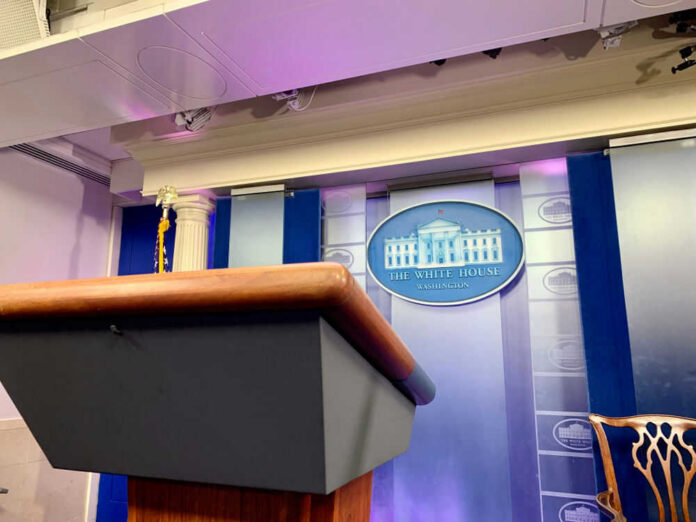
The White House says U.S. “hostilities” with Iran are terminated—even as a U.S.-enforced blockade continues beneath a contested War Powers clock.
Story Snapshot
- The administration claims an April 7 ceasefire ended “hostilities,” pausing War Powers deadlines.
- Experts argue the War Powers Resolution has no “pause” and that a blockade is an act of war.
- Operation Epic Fury’s stated goals: crush Iran’s missiles, navy, proxies, and nuclear ambitions.
- Congressional skeptics press oversight as the Pentagon seeks a $1.45 trillion budget.
White House Position: Ceasefire Equals Termination Under War Powers
White House officials told reporters that hostilities with Iran “have terminated” for War Powers purposes following President Trump’s April 7 ceasefire order. Defense Secretary Pete Hegseth testified that the ceasefire pauses or stops the 60-day authorization clock Congress believed expired late this week. The administration’s argument preserves operational flexibility while enforcing a blockade around Iran. Officials did not specify how long operations might continue, underscoring a live legal dispute over the statute’s meaning and the mission’s duration.
Legal experts cited in reporting dispute the administration’s reading, saying the War Powers Resolution contains no textual basis to pause the clock via ceasefire while forces remain engaged in coercive activities. They also note that blockades qualify as hostilities under international law, complicating the “termination” claim. The tension mirrors past executive-legislative friction over Libya and other conflicts, yet this approach—declaring termination while continuing a blockade—marks a novel and more aggressive interpretation that invites congressional pushback.
Operation Epic Fury: Objectives Framed as Finite and Decisive
President Trump announced Operation Epic Fury in early March with clear targets: destroy Iran’s ballistic missiles and production capacity, annihilate its navy, sever support to terror proxies, and prevent nuclear weapon acquisition. Senior officials, including Secretary of State Marco Rubio, Chairman of the Joint Chiefs General Dan Caine, Press Secretary Karoline Leavitt, and Deputy Chief of Staff Stephen Miller, reinforced those aims throughout March. The White House presents the campaign as decisive and finite, insisting the ceasefire reflects substantial progress while preserving leverage to prevent Iranian reconstitution.
Administration messaging emphasizes national defense, energy security, and deterrence against the world’s leading state sponsor of terror. Officials describe dismantling Iran’s power projection so it cannot threaten U.S. forces, allies, or maritime routes. Supporters argue this approach corrects past permissiveness and reverses gains Tehran made under softer policies. Critics counter that the lack of a defined endpoint and continued blockade risks sliding into open-ended commitments, even if missile batteries and naval assets have been degraded significantly during the operation’s initial phases.
Congressional Oversight and the War Powers Fault Line
Senators confronted Hegseth during a budget hearing, where Democrats voiced outrage and Republicans signaled skepticism about the “paused clock” claim. Lawmakers had assumed the 60-day deadline was imminent, potentially forcing a vote. The White House’s “termination” stance defers that showdown while maintaining pressure on Tehran. The Brennan Center’s Katherine Yon Ebright argues the statute’s plain text does not allow pauses and that continuing a blockade keeps hostilities active, a position that could frame forthcoming oversight or legislative action.
Congress now faces a decision: accept the executive branch’s interpretation, challenge it via resolutions, or seek court review where justiciable. The Pentagon’s $1.45 trillion request makes the stakes concrete for taxpayers who demand both security and fiscal restraint. For constitutional conservatives, the issue is not only defeating Iran’s aggression but ensuring that any sustained use of force reflects accountable, limited government consistent with the separation of powers the Framers designed.
Strategic Costs, Energy Risks, and Constitutional Guardrails
The blockade’s success and risks converge in the Strait of Hormuz, where energy markets react to any disruption. Continued enforcement without fresh authorization could raise oil volatility and consumer costs if shipping tightens, even as it constrains Iran’s cash flows for missiles and proxies. Allies who rely on secure sea lanes may welcome Tehran’s setbacks yet worry about prolonged uncertainty. The administration argues decisive pressure today prevents a costlier conflict tomorrow by denying Iran rearmament windows.
For conservatives, two principles must move in tandem: finish the mission that protects Americans and allies, and keep faith with the Constitution’s balance of powers. The record shows Trump reaffirmed the long-running national emergency on Iran and defined concrete military goals. The legal dispute over “termination” versus “hostilities” should be resolved transparently. Congress can demand metrics on missile destruction, naval neutralization, proxy disruption, and nuclear prevention so victory is measurable, not rhetorical—and so emergency powers remain exceptional, not permanent.
Sources:
White House claims Iran war ‘terminated’
President Trump’s Clear and Unchanging Objectives Drive …
Addressing Threats to the United States by the Government …